
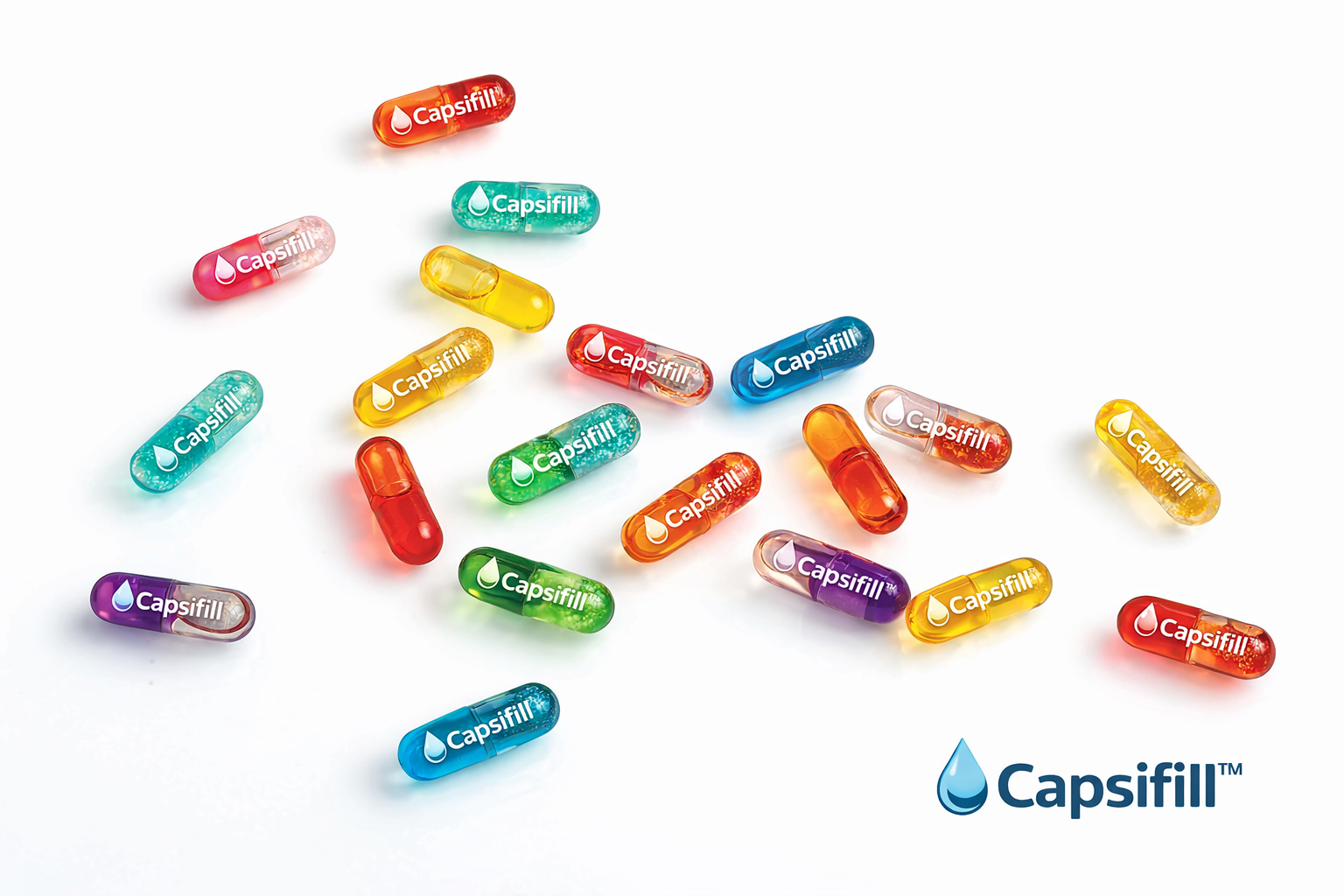
Capsifill Technology : Designing the new dosage format
Capsifill = liquid-fill capsule technology designed to improve delivery of suitable actives, especially oil-soluble, poorly water-soluble, taste-sensitive, and oxidation-sensitive ingredients.
That is scientifically defensible because the main advantage of liquid-fill systems is that the active can be delivered already dissolved, dispersed, emulsified, or pre-solubilized, instead of waiting to dissolve after swallowing like many tablets and powder-filled capsules. Reviews on lipid-based and self-emulsifying systems consistently report improved solubility, dissolution behavior, and oral bioavailability for poorly water-soluble actives.
What advantages you can credibly offer under Capsifill
1. Faster and more efficient release for suitable actives
A tablet or powder-filled capsule usually requires the ingredient to first disintegrate and then dissolve in GI fluid. In a liquid-fill capsule, the ingredient can be present in a pre-dissolved or pre-dispersed state, which reduces that dependency. This is especially useful for lipophilic nutraceuticals and botanicals with poor aqueous solubility. Reviews on SEDDS/SMEDDS and lipid-based oral formulations describe this as one of the key mechanisms for better absorption.
Suggested claim language:
“Helps deliver actives in a pre-solubilized liquid format for improved dispersibility and absorption potential.”
2. Better bioavailability potential than tablets or powder capsules for poorly soluble ingredients
This is your most valuable claim area. It is not universal, but it is often true for the right molecules.
Published human data show that formulation format can make a very large difference:
- In one CoQ10 crossover study, an emulsion in a soft gelatin capsule produced an AUC 927% higher than a hard gelatin powder-filled capsule.
- In another human CoQ10 study, a solubilized CoQ10 gel outperformed standard softgels, powder-filled hard-shell capsules, and tablets; its relative bioavailability was reported at 319% versus the standard comparator set at 100%.
- A recent review on vitamin D3 bioaccessibility notes that a meta-analysis of clinical studies found oil vehicles such as capsules or liquids performed better than powder tablets for vitamin D3 bioavailability.
Suggested claim language:
“For selected poorly soluble actives, Capsifill technology can improve bioavailability compared with conventional tablet or powder-filled formats.”
3. Particularly strong fit for lipophilic actives
Capsifill is best justified for ingredients such as:
- omega-3 oils
- CoQ10
- curcuminoids
- carotenoids
- vitamin D, vitamin K2, vitamin E
- oil-soluble herbal fractions
- cannabinoids where legally permitted
- certain fat-soluble combinations
The reason is straightforward: lipophilic actives often show poor dissolution in aqueous GI conditions, while lipid vehicles and self-emulsifying systems can enhance their intestinal presentation and absorption. Reviews and formulation papers repeatedly support this mechanism.
Suggested claim language:
“Ideal for oil-soluble and poorly water-soluble actives.”
4. Better content uniformity potential for low-dose lipophilic actives
Tablets and powder capsules rely on powder blending, and blend segregation is a known manufacturing challenge that can affect dose uniformity. Liquid-fill systems can reduce this risk when the active is molecularly dissolved or uniformly dispersed in the fill matrix. That does not automatically guarantee superiority, but it is a valid formulation advantage.
Suggested claim language:
“Supports more uniform distribution of suitable low-dose actives within the fill matrix.”
5. Better taste and odor masking
This is a very practical commercial benefit. Strong-tasting oils, botanicals, and sulfur-containing ingredients are easier to mask when enclosed in a sealed capsule shell than in chewables, powders, or some tablets. Softgel and liquid-filled capsule systems are widely used for exactly this reason.
Suggested claim language:
“Encapsulated liquid format helps mask unpleasant taste and odor.”
6. Can support lower excipient burden in some formulas
Many tablets need binders, disintegrants, lubricants, glidants, coatings, and compression aids. A liquid-fill capsule may sometimes simplify the system, depending on the formula. This is not always true, but it can be true for premium nutraceutical concepts where the active is well suited to an oil or liquid carrier. This is more of a formulation and marketing advantage than a universal clinical advantage.
Suggested claim language:
“Enables elegant formulations for selected actives without relying on heavy compression systems.”
7. Better platform for combination-delivery systems
Capsifill can be positioned as a technology that allows:
- oil-based solutions
- suspensions
- self-emulsifying systems
- liposomal precursors
- phospholipid complexes
- semisolid matrices
That gives you room to create differentiated SKUs instead of generic tablets. Reviews on SEDDS and lipid systems support this platform value.
What you should not claim broadly
Do not claim these for every Capsifill product unless you have product-level data:
- “More bioavailable than tablets” for all products
- “Faster absorption” for all products
- “Clinically proven superior” unless you ran a study on that exact product
- “Easier to swallow” as a blanket claim
On swallowability, the evidence is mixed and depends heavily on size, shape, and coating. Some studies do not show capsules always beating tablets.
So the better route is to say:
“Capsifill is designed to enhance delivery of suitable actives”
rather than
“Capsifill is superior to tablets in all cases.”
Best science-backed brand pillars for Capsifill
I would define Capsifill around these 5 pillars:
1. Pre-solubilized delivery
Active can be delivered dissolved or finely dispersed, rather than as compressed powder.
2. Bioavailability enhancement potential
Especially for fat-soluble and poorly water-soluble actives.
3. Precision fill uniformity
Useful for low-dose, potent, lipophilic actives where powder segregation can be problematic.
4. Sensory protection
Helps mask taste and odor.
5. Premium formulation versatility
Supports advanced lipid, emulsion, and self-emulsifying systems.
